

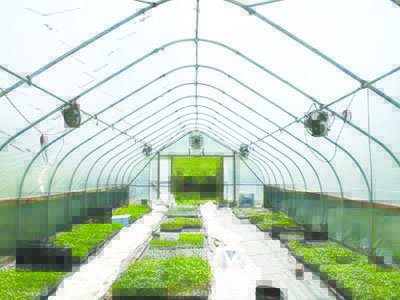

Experts have introduced greenhouses for agricultural development, according to DANIEL ESSIET.
The population of Nigeria is growing rapidly. According to the forecast, in 2050 it will reach about 250 million. This means that the agricultural sector will face new challenges.
Among food producers, the challenge is to counteract the effects of unstable precipitation, increase productivity and use water efficiently. They have deployed old technologies to combat pests, diseases and climate change. Farmers have learned new skills to make the most of their harvests.
Added to these are the growing demand for products in Europe, which has increased imports of African tomatoes, cucumbers, peppers and herbs.
With small-scale farmers affected by the strict food safety regulations of the European Union (EU) arising from high levels of agrochemicals, they turned to greenhouses that do not require chemicals and offer the best yields in vegetables.
The Executive Secretary of the Association of Agricultural Producers of Fresh Producers and Exporters of Nigeria (AFGEAN), Mr. Akin Sawyer, said that the greenhouse is the answer to the problems that farmers face in growing vegetables in the open field.
This is because there are fewer requirements for chemicals, manure, and that the crop is protected from rain and sunlight, he said.
According to him, insects destroy vegetable crops, but their threat in the greenhouse is minimal.
Sawyer said that greenhouses are ventilated, and the crops grown inside them have controlled temperature, humidity, light intensity and irrigation.
He noted that the method is also effective for protecting plants from adverse climatic conditions, such as wind and cold.
Since the start of greenhouse production, farmers have made significant progress in agribusiness; Tomatoes and sweet peppers grown without soil are sold in local products such as Shoprite.
Dizengoff Nigeria has partnered with Best Food Global to promote the production of high-quality vegetables and crops that will be harvested year-round using new technology.
Organized by a duet in Epe, Lagos, Managing Director of Best Foods Fresh Farms, Mr. Emmanuel Ijere, said that with the development of greenhouse technology, many farmers will produce more.
Ijewere regretted that although there are about 4,000 greenhouses in the country, 50 percent of them are comatose due to the lack of government control.
“We are also working with banks and government agencies to find how to finance farmers to use this technology. We all have to work together to come up with solutions to make finance available for this technology. ”
Ijewere said that Dizengoff provided 20 greenhouse kits for its best-selling branded food.
He added that the kits helped strengthen their production capacity.
Ijewere added that the greenhouse was one of the best in Lagos with a capacity of 30 metric tons per season.
He added that this would allow the firm to meet the huge demand for fresh vegetables in Lagos and other parts of the country.
“It is obvious that our ability to produce higher quality vegetables will improve significantly. And if you make calculations, it means that we can do more for our clients, ”he said.
“Thanks to greenhouse technologies, you can make a profit on investments for 18 months, and growing vegetables with greenhouses is certainly beneficial and healthy.”
He announced that the partnership will introduce 100 greenhouse tents by the end of the year in Lagos to increase the production of tomatoes and vegetables to meet domestic demand
“We just scratched the surface and you already know that about 70 percent of tomatoes are imported. In Nigeria, there is a huge greenhouse market. In fact, there is a huge market for quality vegetables. Tomato is a very sensitive product, which, if you need to transport it from one place to another, it will not be available to end users. Lagos is the largest city in Africa, where about 24.5 million people live, so there are many opportunities for greenhouse facilities, ”Ijevere said.
Ijewere said that the kits contain everything farmers need, from seeds to greenhouses to fertilizers. He offers farmers monthly checks from the agronomist.
The chief executive officer, Dizengoff, Mr. Antti Ritvonen, said that his greenhouse technology aims to provide farmers with year-round technology to increase the yield of greenhouse crops such as tomatoes, peppers, cucumbers and sweet melons, as well as ensure sustainable income farmers.
“It also implies the transfer of knowledge to farmers to improve the quality of their products, reduce local losses and ensure higher profits,” he said.
He expressed optimism about the future of agriculture in Nigeria and the country's potential for a short time to become self-sufficient in food production.
Ritvonen, explained on the field day, that agriculture was a special technique, profitable and one-stop-shop for achieving food security.
Therefore, he called on banks and government agencies to provide farmers with access to greenhouse investments, adding that there is a huge opportunity to invest in greenhouse technologies to meet the ever-growing demand for agricultural needs in Nigeria.
He said that Dizengoff built more than 4,000 greenhouses, which is about 80 percent of the total number of greenhouse projects in the country.
He assured investors that with the use of greenhouse technology, the return on investment was after 18 months, as well as the growth of quality and healthy vegetable crops.
He stressed the need for Nigeria to be aware of global trends, stating that the number of greenhouses in Nigeria is far from what is happening in the global market.
Ritvonen said that Nigeria has everything necessary to feed itself, Africa and other regions of the world, provided that mechanization is combined with advanced knowledge-based methods in modern agriculture.
He added that farmers need to understand that the agricultural business is good if people can do it right, considering it as a serious investment that can bring great returns.
He reaffirmed Dizengoff’s willingness to partner with state governments, agencies, corporate and individual farmers in modern technology, equipment and a contribution to more prosperous Nigeria.
The project manager for integrated countries, Dizengoff, Oscar Valumbe, said that greenhouses should ensure that they have the right ingredients, such as certified seeds, clean water, pests and disease-free farms.