


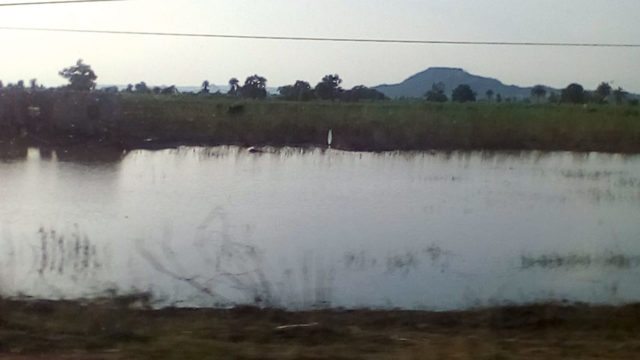


Flooded farm in Kebbi State
As the world celebrates Food Day tomorrow (October 16), scientists, farmers, and entrepreneurs have proposed practical ways to solve food production problems, rather than empty crying and cosmetic approaches from the government.
They suggested, among other things, finding solutions in large investments in new irrigation infrastructure, rehabilitation of existing ones, agricultural insurance, mitigation strategies for climate change and prevention of agricultural activities in flood-prone areas as holistic ways to prevent desertification of agricultural land and food shortages.
On 4 October 2018, the Minister of Agriculture, the head of Audu Ogbe, reported that there might be food shortages, since the flood affected some large rice-producing countries, and that the country may be deficient in rice and corn, in particular, if not addressed, confirming the problems, already voiced by Nigerians.
Factors of the food crisis in Nigeria
Crises of clashes between herders and farmers in the country, especially in the North Central; Boko Haram rebellion in the north-east and flooding in the south, in addition to labial services for the entire important sector, are notable among the factors affecting food production in the country. At the peak of the destruction of the farm by the stream, Odu said, the government will find a way to help farmers affected by the flood, saying that farmers have lost everything they planted in some states.
“There are different varieties of rice that are produced at the National Agricultural Seed Council (NASC), such as Faro 66 and 67, that are tolerant to floods,” said Ogbe, concluding: “Otherwise we will have serious problems with rice , millet, sorghum and corn next year. ” Since this government has recognized the propensity for food shortages, it clearly implies that there is indeed a reason to worry, because without natural disasters, the country has repeatedly failed to compare its annual food production with consumption, which leads to large import bills.
An apology from the state of Ondo
Ondo is one of the flood affected countries. The common enemies of farmers are pests and parasites, but now there are other artificial factors, such as the encroachment of shepherds on agricultural land, which often leads to confrontation between farmers and shepherds. Recently, in the center of the North Senate District, as well as in the northern regions of Akure-North and Akure-South, where farmers are moaning under huge losses in agriculture, there has been a grand confrontation.
A farmer, one Bosun Faihun, who fell victim to a cattle farm in the Arodoe community, the local government district of Akure South, expressed regret that Fulani’s hooligans were impinging on him and other farms and destroying food. Fayehun said that agricultural products such as yam, cassava, cocoa, palm plantation, vegetables, corn and others, were destroyed.
Another farmer from the Eleyovo community, the local government of Akure-North, Ms. Benedict Olasunkanmi, argued that the shepherds of Fulani had seized some farms in the forest and had turned some areas into their permanent settlements. In some areas, such as Uso, the local government of Ovu and Ogbes, Akure, the northern local government, and the Indian cannabis peasants seized most of the agricultural land, forcing the plantations to also catch fire for their own selfish gains.
Ms. Adenike Adeolu, a farmer who accused government officials of protecting Indian cannabis farmers, explained the degradation of the farm before the influx of intruders from Edo and Kvale into the state forest. Vegetable and rice farmers on the banks of the Ogbeze River also described the recent flooding as the cause of the huge loss of agricultural investment.
Although few shepherd attacks on farmers in the southern Senate district of the state, coastal communities in Elijah and Ese Odo still suffer from natural disasters due to flooding. The fish farmer in Ibbokod, Mr. Val Atihosan, said: “Flooding creates many threats to our agricultural activities. Often, floods overwhelm our ponds and sweep away all of our investment in fish. “Our land is not suitable for most crops. There is a shortage of land and repeated oil spills. All of our efforts in improvisation and management do little that we have in most cases at the mercy of floods, especially during rainy seasons, ”he added.
“Kano farmers lose 5,000 hectares of agricultural land in the amount of N4 billion
The chairman of the Association of All Farmers (AFAN) in Kano, Farouk Moody, raised the alarm that about 5,000 hectares of agricultural land had been destroyed by flooding, which could lead to food shortages and the inability of affected farmers to return to their farms. are located in Varava, Woody, Bunker, Rano, Cabo, Rimin-Gado, Gesava, Gabazava and Gvartso, among other state local governments.
Speaking to The Guardian on development issues, Moody explained that farmers lost agricultural products valued at N4 billion, while many of them were going to harvest. “We had terrible losses during the flood, because our participants recorded significant losses. If you ask for a face value, I’ll say that farmers in Kano have lost about 4 billion dollars, ”he said.
With regard to the effects of flooding, he stressed that there could be food shortages and, therefore, the high cost of food. “Lack of agricultural products is inevitable, because the expected yields may not be visible. Again, food prices may increase because, as you see, many farmers will not have what they expect, and therefore scarce products can become very expensive, ”said Moody.
Talking about the ugly experiences, Abdulrashid Labaran Hassan, a rice farmer in the city of Zangul in the local government district of Azingi in Kano, who lost two hectares of land for flooding, regretted that the loss for several days gathered about 100 bags of rice. Abdulrashid said he lost 200 bags of paddy in the amount of N2 million. In less than three weeks. The price of a bag of corn (raw rice grains) ranges from N10,000 to N13,000. Consequently, he lost no less than N2 million for the flood.
State disaster in Kebbi
In Kebbi, an advanced state of rice production, more than 200 communities were immersed in a recent flood, which also destroyed many hectares of agricultural land.
Addressing our correspondent, one of the victims of the floods in Dakngari, the local government of Suru, Mallam Hussein Nma, said that the government had abandoned them without any financial support, food and other necessary provisions.
Confirming the incident with the journalists, the Executive Director of the State Emergency Management Agency (SEMA) Abbas Rabiu Kamba said that the flood damaged several houses and agricultural land.
Abbas said that the affected areas of local government were Suru, Bagudo, Yauri, Sanga, Ngaski, Dundee and some parts of the local government district of Arugugu.
The head of the village of Kania Alhaji Isa Dan Hassan claimed that the flood, farmland and food were washed away by the flood, calling on the government to help.
Farm Coscharis in Anambra
The state Anambra also suffered terribly. The worst areas include East and West Anambra, parts of Aiamelum, Ogbara, North North, North Onitsha District and areas of the South Onitsa Council. The farms of Kosharis and other heavily cultivated areas were also sunk. Most of the victims said their losses were worth billions of naira, both in agricultural products and in property. One of the flood victims in Anambre West, one Friday in Ekuov, claimed that the flood had a negative impact on his livelihood.
The way forward
As interested parties have suggested, in addition to crying and short-term approaches, long-term solutions for agricultural land and food damage include the following.
Dry season irrigation facilities
Dr. Francis Nvilin, Country Director and Regional Coordinator for the Rice Center of Africa, Ibadan, offering solutions for floods in rural areas and probably food shortages, said that rain agriculture cannot support Nigeria’s food needs if The goal is to provide independence in food production. In Israel and Egypt, there is very little rainfall per year, but they are mostly safe for food using irrigation tools.
The rice cultivation scientist said that intelligent scientists and agricultural experts are urging the government to develop irrigation facilities in all parts of the country, wondering why the country finds it difficult to create the most important and basic facilities for changing gambling. He argued that the distribution of Faro 66 and 67 by the federal government, developed by its center for flash floods, is a cosmetic approach and a political statement. He said that species could not withstand severe floods, as they did now, but were designed for flash floods.
“The outbreak will occur no more than two weeks, and the plant will recover. But there is no plant that can recover when the flood lasts for several months, as we see now, "said Nvilena." So the way out for Nigeria is to develop irrigation facilities. Kano has many irrigation facilities. Some other northern states also have irrigation facilities, which is why they can produce some crops during the dry season.
“But in the south, all of our agriculture feeds on rain. Thus, our campaign is that irrigation facilities should be installed in the south, and those located in the north should be expanded. The government should invest in agricultural infrastructure, ”he demanded. In each state, he said, there should be at least one irrigation tool, depending on the areas of comparative advantage. In areas where food crops are produced, there should be more irrigation facilities.
For example, Ishkhein in the state of Oyo produces rice, and irrigation facilities should be installed there. Iwo in Osun State, for another example, produces rice. In this case, mass irrigation facilities should be developed. Patigi, Share and the neighborhood in Kwara produce rice and sugarcane, and irrigation facilities must be developed for them. In particular, Bayelsa, Rivers and Delta have the potential to grow rice, but flooding becomes a problem in the rainy season. Irrigation for dry farming is becoming a better option, suggested Nvinell. He recalled that former Minister of Agriculture Akin Adezina emphasized dry seasoned rice farming, saying, "Let the government identify areas in some states and display them for irrigating funds for crop production."
Dry farming of rice and other crops has advantages, including flood prevention, fewer pests and weed infestations, low post-harvest losses and full-year production.
Agricultural Insurance
Agricultural insurance is also being promoted as one of the ways to mitigate the effects of farm destruction. Insurance coverage can mitigate risk, protect capital, and protect farmers ’funds. Although the Nigerian Agricultural Insurance Corporation (NAIC) reassured affected insured farmers and farmer groups in various states that the corporation is mindful of its corporate responsibility to help them and plow them back to prosperity through the timely payment of appropriate compensations, only a few farmers are insured in Nigeria.
Conventional insurance among educated Nigerians was not covered in part because of issues of trust, and agricultural insurance is becoming more challenging since most plant growers are either flawless or semi-literate. The Corporation, in a statement signed by its Managing Director / Chief Executive Officer, Ms. Falashade Joseph, advised affected farmers to immediately inform the closest NAIKA office in their state of torment.
To increase insurance coverage in the food industry, the head of the agricultural and microinsurance / national coordinator of the Leadway Assurance Company, Mr. Ayo Fatona, advocated a massive campaign and training farmers for insuring their farms. The participation of insurance companies, Faton added, will help identify potential risks to agriculture and other agricultural activities, prepare for this example, take some active steps and mitigate the consequences in case of unsuccessful events. He argued that almost all forms of threats to agricultural activities are currently covered by insurance, at least to get farmers on their feet during calls. However, insurance coverage could not re-incur loss or damage to food, although this could lead farmers back on their feet after falling.
!function(f,b,e,v,n,t,s){if(f.fbq)return;n=f.fbq=function(){n.callMethod?
n.callMethod.apply(n,arguments):n.queue.push(arguments)};if(!f._fbq)f._fbq=n;
n.push=n;n.loaded=!0;n.version=’2.0′;n.queue=[];t=b.createElement(e);t.async=!0;
t.src=v;s=b.getElementsByTagName(e)[0];s.parentNode.insertBefore(t,s)}(window,
document,’script’,’https://connect.facebook.net/en_US/fbevents.js’);
fbq(‘init’, ‘1797528920521807’);
fbq(‘track’, ‘PageView’);