

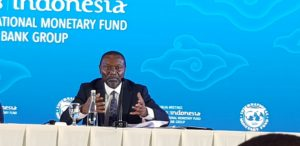

The Minister of Finance and National Planning, Senator Udoma Udo Udoma, said on Thursday that Nigerians might have to wait another two years before seeing the impact of foreign investment in the country.
The Minister made this statement in Bali, Indonesia, at the opening of the Regional Economic Perspective in South Sahara.
Udoma said that it would take at least two years to fully manifest the investment opportunities of the Economic Recovery Plan and the growth of the federal government.
He said: “I think it will take one or two years before they really bear fruit.
“However, the government has created a cod team of four experts who were recruited to work with private sector stakeholders on how to actually attract the expected investors in accordance with the economic plan.
"The Nigerian government expects to attract $ 22 billion in private sector investment through ERGP Oriented Laboratories during this period."
The minister also said that the government, through the ERGP, hopes to create about 15 million jobs by 2020.
Udoma said: “We intend to achieve this mainly by stimulating the private sector.
“Our goal is to make Nigeria a more investment-friendly place, a more attractive place for people to do business.
“We conducted industry-specific laboratories, which we called ERGP Focus Labs, to attract potential investors and government officials together to try to eliminate bottlenecks and obstacles hindering investment projects.
"We have allocated more than $ 22 billion in potential investments that could be unlocked if we can eliminate some of these obstacles."
Udoma said that in Nigeria, the government was forced to cut growth forecasts for 2018 from three percent to 2.1 percent due to problems with oil production in the second quarter of 2018.
He also said that floods in some states affected the agricultural sector, as did shepherds in certain areas.
With regard to foreign investors, Udoma agreed with the IMF’s policy recommendations that Nigeria needs to implement sound macroeconomic management policies to mitigate the risks associated with unstable capital flows.
In addition, Abbe Selassie, director of the IMF's Africa Department, representing regional perspectives, said that the recovery of sub-Saharan Africa’s economy is expected to continue to grow.
According to him, growth in 2017 will be 2.7 percent to 3.1 percent in 2018 and 3.8 percent in 2019.
Udoma said: “Growth will improve primarily for oil exporters, while countries that do not have resource potential continue to grow strongly, with quite a lot growing by six percent or more.
“Despite progress in reducing the budget deficit, more attention needs to be paid to increasing revenue to support ongoing development and debt servicing costs.”
According to 2018, in the framework of the “Regional economic growth of Africa in sub-Saharan Africa”, in order to grow, the region must create at least 20 million jobs per year to absorb new participants in the labor market.
The IMF, in its report, recommended that the region take policy measures to encourage deeper trade and financial integration in the context of Continental free trade in Africa.
He also advised the region to eliminate market distortions, improve the efficiency of public spending, promote digital communications and a flexible education system, and help create conditions conducive to private investment and risk.