

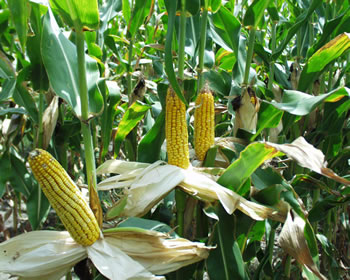

 Nigeria is the largest maize producer in Africa. Nigeria produces about eight million tons of this food crop annually. Corn is grown throughout the country, and the leaders in this crop are Niger, Taraba, Kaduna, Adamava and Plateau. They have the largest corn plantations, and in previous years they sold the harvest at a profit.
Corn farmers in Nigeria suffer from low yields per hectare as a result of attacks against pests and diseases and, mainly, do not apply advanced experience in the production of maize, which contributes to higher yields.
This setback has been delayed for many years, which leads to the frustration of farmers and discouragement from entering into corn production, which leads to a shortage of corn throughout the country.
Recently, the Green Innovation Center for Agriculture and Food Sector (GIAE) began training in Kaduna in good agricultural practice (GAP) for corn farmers.
According to GAP trainer, Zacharia Szabo, “Good agricultural practice concerns planting dates, knowing the variety of seeds that you have to plant and use for fertilizer application, so we really take it with greater speed, most of them have improved lives, especially the 14 groups that I trained.
“We are engaged in a training module for the module, we have five modules for training all cooperative societies. The first module is to choose a site to know the farm division, to tell them how to measure the farm using GPS, walking or tape, we taught them different methods for measuring the farm. ”
This GAP training helped corn farmers in Kaduna understand the best corn production practices that helped increase their yields and make money selling their products.
Ms. Veronika Turaki from Cacau, Chikun LGA, Kaduna State, who participated in the GAP training, said: “Cultivating corn has never been profitable until I started using the best practices I learned during my training, now I doubled my income per hectare.
“The training taught us how to choose the best soil for the crop, I know how to choose a farm suitable for corn, they taught me how to clean the land before I decide to farm. First I need to know how to arrange how I will grow corn, which begins with choosing a farm, cleansing the land, then I should have had seeds that are certified seeds.
"Until now, I did not know how to measure my farm, but now GAP training taught me to measure it without using any machine, I learned to measure with my feet, I know when it is one hectare, if I go and count it, then I know how many ridges I will have in this area, then after cleaning I will improve, all my inputs are ready, I make ridges, measuring them in centimeters.
“Then, when I plant my corn, I know the distance I observe to ensure good yields, then I was taught how and when to spray chemicals after planting on the farm. Then, when the corn germinates, from eight to ten days, I will make my first application of fertilizer, that is, NPK 15/15 or 20/10/10, and I will know how many bags are applied per hectare. They taught us that we need from six to eight bags per hectare, and then after three weeks we learned that we would use fertilizer for urea, it would take two to three bags per hectare.
“They told us to always watch our farms when I go to the farm, if I observe any disease, I will contact the agro-dealers to get the chemicals and eliminate the disease. Before we didn’t know about all these things, from childhood farming was my job.
“During the harvest, I will not leave the corn to dry on the farm, they taught me the right time to harvest.” In the past, after harvesting, we did not know how to keep them, but now GAP taught us to use tarpaulin, but if there is no money to buy tarpaulin, we use a cement bag, we make tarpaulins with it, harvest there, then dry under the sun.
ALSO READ: IBB owner, Sunny Ogoda, dead
“After drying, then during the packaging, which is more important to me, because in the past, any chemical we received we simply mixed it with grains, and then, when it was consumed, would cause illness, but they would give us special bags, I use them for packing grain, ”she said.
Ms. Turaki said she received enough money from her recent harvest after training GAP. She said that all the money she used to purchase funds for the farm season this year was realized as a result of the sale of corn last season. She also said she pays her grandchildren's school fees for money that she equally understands from corn sales.
"I can say that I earned money on growing corn, because what I get per hectare is more than what I had in the past, compared to last year I received up to 49 bags of corn per hectare, but I used to adopt the GIZ model, I did not get up to 20 bags per hectare, sometimes I used up to 15 bags per hectare.
“But I cannot consume these 49 bags, even if we are under 10 in the house, we cannot finish 49 bags, so this year, before we started farming, I know how many bags of corn I sold, collect money to buy all the resources we need on the farm without stress, and we still have bags, and we have money in the house.
"Adding value to the cultivation of corn is very nice, because from there I can sell one bag of corn at N13, 000 and buy cowlea (beans), which I don’t grow, as you can see when growing corn with the GIZ model, we are very happy and appreciate the people who brought it.
"This is from the money that I realized from selling my corn, which is used to buy fertilizers, chemicals and other things that I used in agriculture this year, and then the rest of the money, I collected capital for my store, I sell shea butter, wrap, I process nuts with nuts, so I raised my capital from selling some of my grains.
“I have my grandchildren, I pay for their school fees, one of them is in SS1, I sold half of the bag for N5,500, I already gave him registration money, bought uniforms and sandals and other things, I can not gather to take money from people, ”said Ms. Turaki.
Meanwhile, the trainer, Mr. Sabo, said: “Farmer’s classes are taking place, and they appreciate it, even people from Israel, China come to our farms, they appreciate it, because we really accept good agricultural practice.
"We taught them how their raw materials, how to prepare for the earth, how to apply fertilizers, when to harvest and the type of varieties they are going to use, we have many varieties, there is an early mature variety, we have been taught when to sell the crop after harvesting , we are trying to teach them to sell products in cooperatives and sell suppliers.
“I graduated from about 14 cooperatives, and each cooperative has 30 members and is now working with 8 cooperatives.”
In Talele, Chikun LGA, Mr. Joseph Michelle processes 18 hectares of corn after gaining knowledge at the GIZ GAP training.
According to him, he initially grew 5 hectares, after which he was discouraged because of low yields, but after training GIZ he increased his cultivation to 18 hectares.
“We started this farm with 5 hectares, we gradually increased a hectare, now the total area we covered is 18 hectares. I was almost discouraged because of how things were, we had financial problems, so when we found the GIZ training, I chose courage and encouraged my father to do this, when I participated in the training, there was so much courage that my morale is to increase my corn farm to 18 hectares.
“When I used the old methods of growing corn, the yield per hectare was insignificant, I received 10 to 12 bags of corn per hectare, but when I saw now I expect at least 600 bags of grain from this farm, which will be about 35 bags of hectares.
“After collecting all 18 hectares, I plan to increase the hectare, this farm covers about 50 hectares, so I can grow as much as 50 hectares in the future.
“I learned how to plant corn, how to apply fertilizers and so many other things. I will invest the money that I sell from my corn farm to the farm, I will put a few birds on the farm so that I can get manure from the birds, ”said Michel.
Another corn farmer, Mrs. Esther Daniel, said she plans to begin supplying corn to processing companies, as it is expected that her harvest will increase after attending GIZ training and accepting a model on her farm.
She said: “The GIZ instructor taught us how to grow a farm, so that at the end of the day we make a profit, and the technologies that we received training, we applied it, and it helps our corn, we hope that at the end of the day, we are going get what we expect, so learning really helped us apply fertilizers, intervals, and other things.
"I grow 2 hectares of corn, last year we grew corn, but the harvest was very bad compared to what we expect this year, we received less than a ton per hectare, but this year, as we used the technique, we are hoping that the yield will be more than last year.
This year, I expect that at least 50 bags of corn, after the sale, I want to increase the hectare of my farm, which will make me a big farmer so that I can supply my crop to the processing companies.
"I want GIZ to expand its intervention in the funds, if they have the means to help me either on loans or on deposits, I want them to help me so that I can increase my farm."
In addition, Mr. Sabo noted that “in the Remiyamov farms they were able to process 18 hectares as a result of GIZ motivation, initially they were no longer interested in agriculture because of their previous experience, I met the farm owner, I advised him to send some of his employees to participate in the GIZ training, and he did it, which led them to grow 18 hectares of corn, they grew 5 hectares, but they improved.
“There is another farmer, we call him“ Nariya Global ”, we taught him good farming practices, he expanded his farm to about 9 hectares.
“There is another farmer on the Abuja road in Datsa, Kaduna state, he is a big farmer, although he didn’t grow him the way he should be, so he didn’t make a profit, he participated in the training, and he does well, now he has improved.
“There is a corn farmer, Dunladi-Sauri, he is a big farmer, he did not make much profit in the past, but now, after learning GIZ, he has expanded his farm. The problem that we face sometimes is to bring them to cooperation, it is basically a problem that we face, but since you visit so much and you are a farmer, you keep coming because you understand the language and the discussion ".