By Jim Rex-Lawson Moses
From automated milking machines to computerized green houses; drones to satellites; apps to other scientific inventions; research findings to nutritional needs of plants and animals which will ultimately determine the nature of harvest or output, the business of agriculture in Nigeria is fast changing as practitioners are adopting smart farming methods, a modern farm management concept that requires the use of modern technologies to enhance the quality and quantity of agricultural produce.
Today’s farmer now has access to the internet of things, technologies, data, various soil scanning apps and technology, GPS, and varieties of seeds and animal species.

Through precise measurement and variations in any given field and applying a given strategy accordingly, the effectiveness in the application of pesticides, herbicides and fertilizers can be greatly enhanced. Also, the use of smart farming techniques avails the farmer with better tools to monitor the individual needs of animals to adjust to their corresponding nutritional needs thereby enhancing their total wellbeing and overall output.
Beyond the foregoing, new varieties of crops have evolved through scientific studies and research in various academic and research institutions. For instance, the International Institute of Tropical Agriculture (IITA) has developed draught resistant maize for Northern Nigeria because of the short rainy season in the region and this is greatly yielding outstanding results as this has helped the region to remain consistently on top of the chart for maize production in Nigeria. Disease resistant crops too have evolved through research in science including high yielding varieties of crops. Nigeria can now boast of upland and wetland rice varieties, even species that yield within 90 days.
In 2013, IITA released two extra-early maturing maize hybrids with combined resistance/tolerance to Striga, drought, and low soil-nitrogen.
The extra-early hybrids, originally known as IITA Hybrid EEWH-21 and IITA Hybrid EEWH-26, are now designated Ife Maizehyb-5 and Ife Maizehyb-6. They were developed by IITA and tested extensively in Nigeria in partnership with the Institute of Agricultural Research and Training (IAR&T) through the funding support of the Drought Tolerant Maize for Africa (DTMA) Project.
Other collaborating institutions involved in the testing include the Institute of Agricultural Research (IAR), the University of Ilorin (UNIILORIN), the University of Maiduguri (UNIMAID), and the National Centre for Genetic Resources and Biotechnology (NACGRAB). The DTMA Project is executed by CIMMYT and IITA in 13 countries in sub-Saharan Africa.
Both extra-early hybrids have desirable grain cooking characteristics and outstanding yield and stability across environments in Nigeria ravaged by drought, Striga, and low soil-nitrogen. The potential yield of Ife Maizehyb-5 in Nigeria is 6.0 t/ha and Ife Maizehyb-6 yields 5.5 t/ha. Local varieties yield about 1.5 t/ha.
Hybrid development and promotion is a promising strategy to appreciably increase maize production and productivity and to revolutionize agriculture in West and Central Africa (WCA).
IITA also developed “Aflasafe” to control aflatoxins in maize and leguminous crops.Aflasafe is a biocontrol product that drastically reduces Aflatoxin in maize and groundnut. Aflasafe reduces aflatoxin contamination in food and feed helping farm families to stay healthy, and animals to be more productive. As a result, it increases income and profitability of the poultry industry, and it provides greater opportunities for trade as fewer products are rejected in the market.
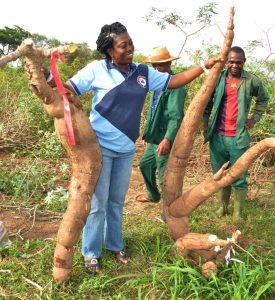
The institute also in 2013 released two improved cassava varieties in a deliberate move to maintain its lead as the world’s largest producer of the root crop and improve incomes of farmers.
The varieties were developed through a collaborative effort with the Nigerian Root Crops Research Institute (NRCRI), Umudike. The two varieties are known as UMUCASS 42 and UMUCASS 43, respectively.
“Both varieties performed well in different cassava production regions of Nigeria with high yield, high dry matter, and good disease resistance. The roots of these varieties are yellow and contain moderate levels of pro-vitamin A,” said Dr. Peter Kulakow, IITA Cassava Breeder.
READ MORE: AFAN Charges FG For Better Structures Before Tomato Importation Ban
The potential maximum yield of the two varieties is between 49 and 53 tons per hectare, according to pre-varietal release trials that were conducted between 2008 and 2010. Local varieties produce less than 10 tons per hectare. The varieties are also resistant to major pests and diseases that affect cassava in the country including cassava mosaic disease, cassava bacterial blight, cassava anthracnose, cassava mealybug, and cassava green mite.
Over the years, cassava has been transformed from being a “poor man’s” crop to a cash and an industrial crop, as it is now processed to products such as starch, flour, glucose, and ethanol, this transition has increased the demand for this root crop.
READ MORE: Guinness Nigeria Drives National Development Through Its Agriculture Scheme
Also worthy of mention are new cocoa varieties in Nigeria that matures and produces fruits from 18 months to two-and-a-half years while the old variety took four or more years. The new cocoa hybrid varieties have the capacity to produce 2,000 cocoa buds per tree compared to 350 buds produced by the old variety. This has helped in reviving the long neglected subsector of agriculture which use to be a major foreign exchange earner.
And just resently, the Stored Research Institute in Ibadan, Southwest Nigeria, developed a natural pest control product which will ultimately lead to an end in the use of poisonous pesticides in preserving grains, a practice which led to the ban of Nigerian beans in the United Kingdom.
The role of science in the advancement of agriculture in Nigeria cannot be overemphasized as scientific findings and innovations now are also greatly impacting egg production in poultry, milk production in cows and all-year-round production of vegetables through the use of green houses. Extensive farm lands can now be cultivated through the use of machines, even smaller machines can now be acquired by small scale farmers to enhance productivity.
Less dependence on rain-fed farming is gradually improving as most farms now depend on modern irrigation systems to water their crops.
This article will not be complete without the mention of fish farming which has been greatly impacted by scientific and research findings thereby enabling farmers to increase production annually.