


Global growth forecast fell for the first time since July 2016
Same week the World Bank lowered its economic growth Prospects for Nigeria, the International Monetary Fund (IMF) followed this, justifying expectations for growth in Africa’s largest economy to 1.9 percent from 2.1 percent in April last year.
In North Nigeria, herder farmers clashed, disrupting crop production and leading to the slowest agricultural growth in two decades, which was the main driving force behind the decline since the IMF joined the World Bank in reducing the growth prospects of Nigeria.
The World Bank this month reduced expectations for economic growth in Nigeria for the year to 1.9 percent from the original forecast of 2.1 percent, also referring to sluggish agricultural products. The local investment bank Vetiva lowered its growth forecast to 1.7 percent from 2.1 percent, pointing to "weak consumer demand, rising environmental costs and a decline in agricultural production."
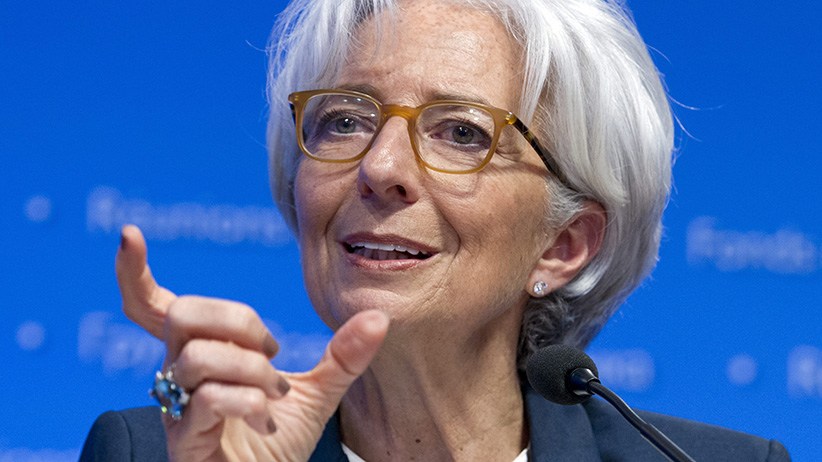
International Monetary Fund (IMF) Managing Director Christine Lagarde, José Luis Magana / AP
These factors tend to offset the impact of higher oil prices, which have risen to a four-year high of more than $ 80 per barrel this month.
A 1.9 percent increase this year means that the average income of Africa’s largest oil producer will decline for the fourth consecutive year, as population growth has consistently overshadowed economic growth since 2015, according to data compiled by Bloomberg.
The IMF expects this trend to continue for another four years.
Despite the fact that over the past decade, the population level in the country has averaged 3 percent, since 2015 the economic growth has been less than 2.5 percent.
Despite an increase in annualized terms, in the second quarter of 2018, the economy slowed to 1.5 percent from 1.95 percent in the first quarter, the state data agency reported, the National Bureau of Statistics (NBS) reported in August.
According to the NBS, agricultural growth almost doubled in the second quarter, an increase of only 1.91 percent from 3 percent in the first quarter, as the growth in crop production fell to 1.49 percent in the second quarter from 3.45 percent in the first quarter.
“Economic managers need to pursue a growth policy in the country that will lead to sustainable and comprehensive growth,” said Ayodele Akinvunmi, head of research at FSDH Merchant.
In a humidifier with investor sentiment, the International Monetary Fund lowered global economic growth forecasts for the first time since July 2016.
Referring to increased tension in trade and stress in emerging markets, a Washington lender reduced its global growth forecast for this year by 3.7 percent from 3.9 percent in April last year.
“During our last“ Prospects for the World Economy ”in April, the dynamics of the world economy on a global scale led us to a forecast of growth of 3.9 percent both this year and next year,” the chief economist of the IMF Maurice Obstfeld He told reporters on Tuesday in Bali, Indonesia, as he explained that events since then have made the Fund’s preliminary forecast overly optimistic.
According to Obstfeld, growth grew by 3.7%.
“There are clouds on the horizon. Growth was less balanced than we hoped. Not only were some downside risks identified that were identified in the past global economic outlook, the maternal likelihood of further negative shocks to our growth forecast increased, ”Ostfeld added.
If the trade war between USA and China according to the foundation, it can significantly bite on global growth.
He estimates that global production may fall by more than 0.8 percent in 2020 and will remain 0.4 percent below the trend line in the long run in a scenario where President Donald Trump follows all of his threats, including global car duties. .
According to IMF models, output may fall by more than 1.6 percent in China and more than 0.9 percent in the United States next year.
“There are several ways in which this news can be digested. One of them is to expect that the expected global growth of 3.7% compared to 3.9% is still a healthy growth rate, given the serious turbulence that the global economy has experienced in the last 10 years ", Said Jamil Ahmad, Global Head of Monetary Strategy and Marketing Research brokerage office, FXTM.
But, on the other hand, according to the IMF, there are observations that the combination of trade stresses and stress in emerging markets is behind a modest decrease in growth expectations, as well as even more alarming comments that the IMF is concerned that global growth may have a plateau , suggests that there are also reasons why investors worry about lowering the IMF rating.
“First, the comment that global growth may have a plateau suggests that current growth rates are as good as the global economy. This means that any global increase in optimism could exceed 4% over the next few years, at best ambitious, ”Ahmad added.
Connected
(function(d, s, id){
var js, fjs = d.getElementsByTagName(s)[0];
if (d.getElementById(id)) {return;}
js = d.createElement(s); js.id = id;
js.src = “http://connect.facebook.net/en_US/sdk.js#xfbml=1&version=v2.6”;
fjs.parentNode.insertBefore(js, fjs);
}(document, ‘script’, ‘facebook-jssdk’));
!function(f,b,e,v,n,t,s){
if(f.fbq)return;n=f.fbq=function(){n.callMethod?
n.callMethod.apply(n,arguments):n.queue.push(arguments)};
if(!f._fbq)f._fbq=n;n.push=n;n.loaded=!0;n.version=’2.0′;
n.queue=[];t=b.createElement(e);t.async=!0;
t.src=v;s=b.getElementsByTagName(e)[0];
s.parentNode.insertBefore(t,s)}
(window,document,’script’,’https://connect.facebook.net/en_US/fbevents.js’);
fbq(‘init’, ‘178119876126721’);
fbq(‘track’, ‘PageView’);