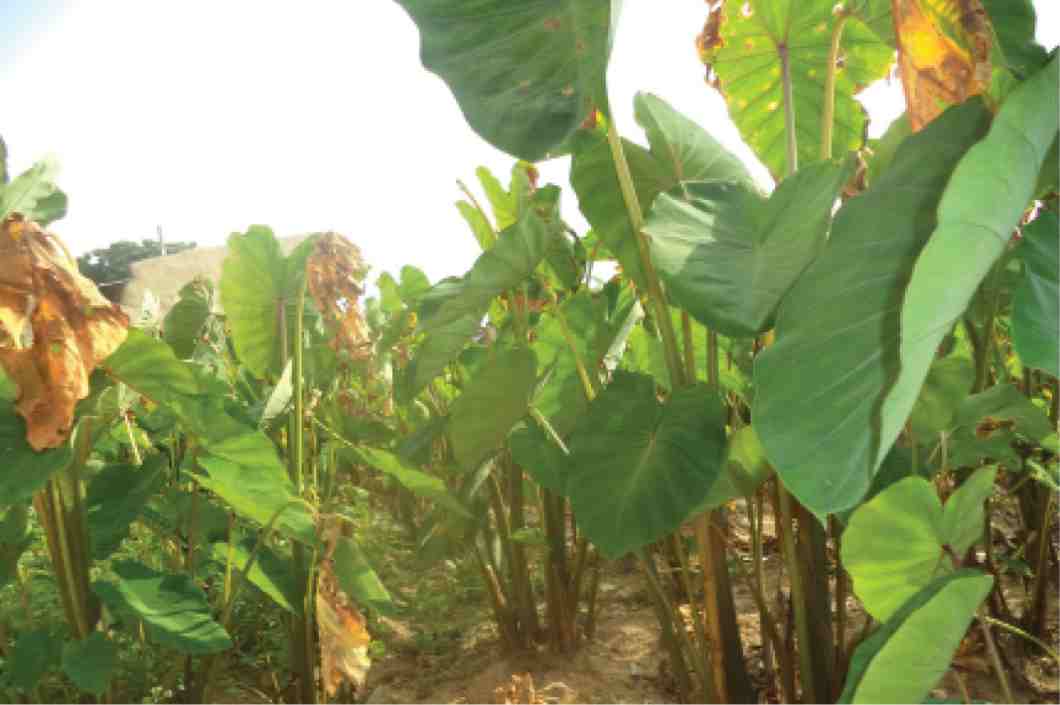

Cocoyam farmers in the state of Katsina expressed concern about how, for nearly a decade, leaf bite disease prevented large-scale crop production in the state.
Fifteen years ago, the southern part of the state of Katsina was well known for the large-scale production of kokoyama. Many traders from the south, east and the country of Nigeria tried to buy products in the state at a very cheap price.
The effect of leaf disease for eight years, however, quickly affects large-scale crop production.
Malam Musa Yusuf, a farmer from Kokoyama in Dankawo, Funtua LGA, said that there are no longer any prospects for kokoam agriculture compared to other crops such as rice, soybean, corn and sorghum in the state.
Persistent leaf burn disease has caused many of us to shy away from growing kokoyama because both state and agricultural companies pay less attention to reducing the terrible disease, perhaps because those who mostly survive in crop production are peasants and vulnerable groups who have neither a voice nor resources affecting his future, ”said Musa Yusuf.
He added that the farmers themselves tried different remedies, seeking to improve the situation, but all in vain, so they resort to the production of corn and rice.
“It is difficult to see a farmer who produces cocoa per hectare or more agricultural land; Many of those who produce it are now processing it on small farms, land plots near the city and the yard of houses, ”explained Yusuf.
Malam Jamilu Sani, who grows tubers in the Bakori market, also said that the harvest quickly comes to an extinction in the markets, because his supply is very poor compared to the past 15 years.
“If you go around the market, you will find that the supply of kokoyama is very poor, as those merchants who came from far to buy a product no longer come. If the government and agricultural companies had taken early measures to contain the disease, the Kokoyam farm had now been successfully improved, ”said Sani.
He added that, despite the low production, the bag of cocoons was not worth more than N5,000, because the products were only classified as local consumption.
Alhaji Murnai Barau, a retired agricultural worker, said that the disease, which has been suffering from kokoyama for many years, requires strategic intervention from both government and private agricultural companies.
“Farmers need to be supplied with new improved kokoyama seeds, because recycling of infected seeds leads to an accumulation of leaf disease and a decrease in crop yields. Similarly, the mode of spreading improves transmission of the disease from one generation to another, therefore the impact of the disease has moved beyond the limits of one damage season, ”said Alhaji Barau.
He added that farmers need to go through educational campaigns on the nature of the disease and how to mitigate it. “It is not deceiving how the farmers of the kokoyama practically remain on their own devices for many years associated with the disease of agricultural crops,” he complains.
Connected